Showing posts with label vitamin D. Show all posts

Friday, October 29, 2010

Vitamin D and P

Not that there's a vitamin called "P" but more along the lines of urinary issues. More pee than the letter "P." We found more research that would verify our speculation that the amount of vitamin D that the government suggests as a maximum and the actual need that has been demonstrated beyond the recommended maximum. Toxicity is the government's concern yet researchers and the Canadian government exceeds the US levels.
"Syracuse gynecologist shows how vitamin D deficiency leads to urinary incontinence - ...found that women of all ages with pelvic floor disorders or urinary incontinence had significantly lower levels of vitamin D. Women age 20 and older, with high levels of vitamin D, had a significantly lower incidence of pelvic floor disorders; and women age 50 and older, with high levels of vitamin D, had a significantly lower incidence of urinary incontinence. Given the increase in the number of patients with pelvic floor disorders, further evaluation of the role of vitamin D is warranted, particularly future research to assess the relationship between vitamin D levels and pelvic muscle strength in women of all ages and racial/ethnic groups," he writes in his summary. Dr. Samuel Badalian says vitamin D levels should be checked annually. Taking 2,000 international units per day of vitamin D3 can provide healthy levels for most people, but those who are elderly, obese or who have renal insufficiency need more." - SYRACUSE.COM (April 20, 2010)
We're including the additional information on Vitamin D because the researchers claim that African-Americans are vitamin D deficient. While Dr. Badalian only suggests more he doesn't really say how much that much more is. The Vitamin D Council goes as far as suggesting 5,000 international units of Vitamin D per day. While the New York State law prevents home test kits for vitamin D deficiency and we couldn't find them at the Council's website if you're African-American it'll save you the costs of a kit. Whether legally available for sale or not.
"Are you vitamin D deficient? Your health could be at risk, but it's easily fixed - Almost without a doubt, the vast majority of African Americans are vitamin D deficient," says Susan Brown, a clinical nutritionist and director of the Center for Better Bones in East Syracuse. She says people with dark skin require about six (6) times the amount of sun exposure as light-skinned people to make vitamin D." - SYRACUSE.COM (August 6, 2006)
We haven't found the studies that says you can get more the 2,000 international units of vitamin D with a suntan. However, if we exercised we'd probably need less supplement and less sunlight. It's just that everyone can't get out but I guess that could be placed in the sunlight with shades. Of course our future would have to be "so bright that we'd have to wear shades." Then again we haven't really researched sunlight and its healthy benefits. However we have to admit George Hamilton doesn't look all that weathered. We do wonder what this millenniums George Hamilton would be. Who among today's youth consider the benefits of the tan - maybe Jersey Shore's Snooki?

Tuesday, October 19, 2010

Vitamin D Prevents

Back in the "gold pepper" story we suggested, based on our experiences, that we all use Vitamin D in combination to make the effects more efficient. Today we found what we thought was the story concerning the effectiveness of Vitamin D in the prevention of breast cancer. The story wasn't from a well-known or respected news source, though we thought it was. We found the story but the research seemed to say something different and we got so excited we didn't know what to do:
"Serum Vitamin D and Cancer Mortality in the NHANES III Study (1988-2006) - Vitamin D has been hypothesized to protect against cancer. We followed 16,819 participants in NHANES III from 1988 through 2006, expanding upon an earlier NHANES III study (1988-2000). Using Cox proportional hazard regression models, we examined risk related to baseline serum 25-hydroxyvitamin D (25(OH)D) for total cancer mortality, in both sexes, and by racial/ethnic groups, as well as for site-specific cancers. Because serum was collected in the south in cooler months and the north in warmer months, we examined associations by collection season ("summer/higher latitude" and "winter/lower latitude"). We identified 884 cancer deaths during 225,212 person-years." - Cancer Research (OnlineFirst)
That's all we can afford, the free abstract, so we don't know the best part that works, for instance, how much worked or needed. The information that we would need to speculate might be in the parts of the research to which we didn't have access. We don't need to access the full research and we will admit that we sometimes miss crucial information that won't be found in the abstract. Which is why we often go to the source institution to find their plain English press releases on their research that often isn't in either the headlines or the story.
Vitamin D Status Is Not Associated With Risk for Less Common Cancers - We did not see lower cancer risk in persons with high vitamin D blood concentrations compared to normal concentrations for any of these cancers,” said Demetrius Albanes, M.D., NCI, one of the study investigators. “And, at the other end of the vitamin D spectrum, we did not see higher cancer risk for participants with low levels.” - National Cancer Institute (News)
Its hard to ignore a thirty-three (33) year study even if it is from a US government agency. We don't generally question the National Cancer Institute (NCI) of the US National Institutes of Health. We don't also take their word at face value. We question. We doubt. We check and we verify. Consider it checked, doubted and verified.
"Researchers and clinicians have looked to the possibility that vitamin D might be used for cancer prevention. Some evidence indicates that higher levels of vitamin D are associated with a lower risk of colorectal cancer, though the evidence is inconsistent. Through the Vitamin D Pooling Project, researchers had access to a geographically and demographically diverse group of men and women, including participants from the United States, Finland, and China." - National Cancer Institute (News)
That's the doubting part that we talked about. The US found one results and the Chinese found another with a more diverse albeit smaller group. We think the difference is in the amount of Vitamin D used to achieve a different result than in America. We aren't scientists and we didn't have access to the full US results but we speculate that since the US minimums are substantially different than levels recommended by US doctors and even Canadian doctors that matters. It is speculation. We also admit that. We're not ready to dismiss the power of Vitamin D which is and has been shown to be effective.
"There appear to be many health benefits associated with adequate intake of vitamin D, including suggestive evidence with colorectal and breast cancers. While the available data are promising, we need to learn a lot more about vitamin D and its potential health effects. We plan continued study of this remarkable nutrient, which will help resolve the many remaining questions." - Nurses' Health Study Newsletter (2008)
Not our opinion but the opinions reached by those with more information and education that all of us combined. We know. This is for those who say the news says one thing one day and another thing the next - you just don't know what to believe. We say you can and you should know what to believe. The news can't give you the nuances that you need to be able to discern your beliefs. We says its in the math. Number of years, number of participants and amounts given thats the math you need to know to firm up your beliefs. If you want to be in the know.
"Randomized trial of vitamin D supplementation to prevent seasonal influenza A in schoolchildren - This study suggests that vitamin D3 supplementation during the winter may reduce the incidence of influenza A, especially in specific subgroups of schoolchildren." - American Journal of Clinical Nutrition (March 2010)
That's the power of vitamin D just in time for those with grandchildren or children, if you're so blessed, flu season and fears that the vaccine could harm them. We say don't be afraid and that your fears are largely unfounded - but we will admit what's true for the majority isn't true for everyone. You have to do what's right for you and your situation. Vitamin D seems to be, if you're not overly supplementing yourself and family now, the answer to vaccine fears.

The amounts given to the children exceed what the government says is the safe high limit for the vitamin. Though the amount given the children didn't exceed the government limits plus the "safe upper limit." While vitamin D can be toxic what the government considers recommended levels aren't the same amounts that professionals recommend.
"Can vitamin D be harmful? - Signs of toxicity include nausea, vomiting, poor appetite, constipation, weakness, and weight loss. And by raising blood levels of calcium, too much vitamin D can cause confusion, disorientation, and problems with heart rhythm. Excess vitamin D can also damage the kidneys. The safe upper limit for vitamin D is 1,000 IU/day for infants and 2,000 IU for children and adults. Vitamin D toxicity almost always occurs from overuse of supplements. Excessive sun exposure doesn't cause vitamin D poisoning because the body limits the amount of this vitamin it produces." - National Institutes of Health (Consumer Fact Sheet)
We're not comfortable recommending exceeding levels beyond what the researchers used in their research. We are curious as to their intentions of the researchers in exceeding the levels in trying to achieve their findings. Again since we can't afford to access the entire study we can't speculate as to what their motivations might have been. We can speculate that researchers don't expect government recommended levels to contribute to our overall health. That's what we'd like to see researched.
"Osteoporosis guide to help treat brittle bones - Take 400 to 1,000 IUs of vitamin D per day for those aged less than 50, and 800 to 2,000 IUs daily for those 50 and older." - CBCNews (Oct 12, 2010)
We weren't comfortable recommending exceeding the US government's levels but the Canadian government feels comfortable doing so for those older than 50. The research shows that illnesses and age can be a time where we get comfortable with what we eat which probably doesn't include a wide variety of fresh foods nor much sunlight all of which decreases our vitamin D levels. When we made our prior suggestions it was without full knowledge of the current research though there was plenty of prior studies that made the suggestion more than likely.
"A recent review article published by Loyola's nursing school researchers concluded that adequate intake of vitamin D may prevent or delay the onset of diabetes and reduce complications for those who have already been diagnosed." -  Loyola University Health System (Newswire)
When we buy vitamin D we go for the cheapest price rather than for any concern for its form. Until the most recent research we bought by the International Unit rather than whether its natural or synthetic. We didn't even realize until we made a recent purchase of the supplement that it was available in two (2) forms. When we sought information from the purchaser we discovered conflicting information than that available from our government.
"Vitamin D is found in supplements (and fortified foods) in two different forms: D2 (ergocalciferol) and D3 (cholecalciferol). Both increase vitamin D in the blood, but the D3 form may do it better and keep levels raised for a longer time. Many supplements now provide vitamin D3 instead of D2." - National Institutes of Health (Consumer Fact Sheet)
What excited us even further was that the vitamin was good at reducing children's chances of contracting the flu. We'd like to speculate that what would work with children would also work with teens and seniors. That isn't quite what the study says. The indication is that prior use might even work against you in the protection department.
"Vitamin D better than vaccines at preventing flu, report claims - Altogether 354 children took part in the trial, which took place during the winter of 2008-09, before the swine flu epidemic. Vitamin D was found to protect against influenza A, which caused last year's epidemic, but not against the less common influenza B." - The Sunday Times (March 15, 2010)
The same way we suggested adding Vitamin D to "gold pepper" to make its health effect work efficient and effective when it comes to the maximum amount of Vitamin D protection combining D with calcium has a more profound and health effect as well. We know you're going to tell us the headline that calcium use can hurt you but if you read the specifics you'll discover the following:
"Calcium pills may raise heart attack risk - A recent study suggested a link between calcium and heart attacks, so researchers from the University of Auckland, New Zealand, reviewed 11 studies of people taking calcium, without also taking vitamin D, which included almost 12,000 people." - CDCNews (July 30, 2010)
That's true that calcium is bad for your heart if you don't take it in combination. Would we speculate that you should add calcium to "gold pepper" and vitamin D? No, not just yet. We need more research to make us take that step. After all we aren't doctors and review the news on health and not the science as much as what's behind the science. Even if we were doctors its doubtful that we'd still be likely to make or take the step of making that speculation. We've been concerned about reactions from combinations and regardless of the source of the supplements they're still chemicals. Reactions are still a major concern.

Wednesday, October 13, 2010

Arthritis Gold Pepper

Arthritis is back in the news and we immediately went to available treatments for this affliction especially since when combined with obesity is a larger problem for everyone. Gnarled bones and appendages does not make exercise either desirable nor comfortable. The more pain you have the less likely you are to move the body to reduce the pain. Your first desire is to simply reduce the pain.

We looked closer into turmeric treatment for arthritis and discovered that our suggestion to add the spice to your food, while it couldn't hurt, doesn't offer enough relief though it is a good, in our minds, way of thinking "brown." The research in 2006 found:
"Efficacy and mechanism of action of turmeric supplements in the treatment of experimental arthritis - ...before turmeric supplements can be recommended for medicinal use, clinical trials are clearly needed to verify/determine whether treatment with adequate doses of well-characterized turmeric extracts can indeed prevent/suppress disease flares in RA patients, as well as to explore any potential benefits of turmeric dietary supplements in the prevention or treatment of more common forms of arthritis in the general population." - Arthritis & Rheumatism (November 2006)
The researchers tested administering the turmeric in rats with injections. When you add piperine to curcumin and feed them to rats or human volunteers the amount that was absorped was greatly increased. It seems that piperine has an affect of making the effects much more effective. Called "bioavailability" adding spices can add life to your living. Spices are the key to life:
"Black pepper and its pungent principle-piperine: a review of diverse physiological effects - Piperine has been documented to enhance the bioavailability of a number of therapeutic drugs as well as phytochemicals by this very property. Piperine's bioavailability enhancing property is also partly attributed to increased absorption as a result of its effect on the ultrastructure of intestinal brush border. Although initially there were a few controversial reports regarding its safety as a food additive, such evidence has been questionable, and later studies have established the safety of black pepper or its active principle, piperine, in several animal studies. Piperine, while it is non-genotoxic, has in fact been found to possess anti-mutagenic and anti-tumor influences." - Critical Reviews in Food Science and Nutrition (2007)
We're going to be adding black pepper, curcumin, turmeric allspice blends to all of our meals. While it isn't the "Big 10" doing the research and indeed few institutions of high learning in the US are doing the studies either. Most of this we can understand as very few school can afford to provide the necessary funding when there isn't a payoff to the institution in funding. Since above mentioned study is India based and a major source of the turmeric or curcumin for the country and possibly for the institution. We'll take the benefits where we can. Now what should we call this concoction of ours? We're thinking gold pepper!
"Vitamin D, curcumin may help clear amyloid plaques found in Alzheimer's - UCLA scientists and colleagues from UC Riverside and the Human BioMolecular Research Institute have found that a form of vitamin D, together with a chemical found in turmeric spice called curcumin, may help stimulate the immune system to clear the brain of amyloid beta, which forms the plaques considered the hallmark of Alzheimer's disease." - UCLA Newsroom (July 2009)
Add vitamin D supplement to make everything work better. Take a vitamin D pill just before we add the "gold pepper" to our meals and we're protected or better off than we were before the day began. We're healthier and stronger than we would be without it. It's not exercise but its a good start. Making everything work more effectively seems so efficient.

Wednesday, September 8, 2010

VitaMazing D

How We Got Here - Sometimes its not a mistake. The men among us think nothing of taking the wrong turn that might lead us to discover a new route. Were always looking for a better route to where we want to go. The same can be found in medical research.
"In a study of Japanese schoolchildren, vitamin D supplements taken during the winter and early spring helped prevent seasonal flu and asthma attacks. The idea for the study, study chief Dr. Mitsuyoshi Urashima, told Reuters Health, came from an earlier study looking at whether vitamin D could help prevent the bone-thinning disease osteoporosis. The researchers in that study noticed that people taking vitamin D were three times less likely to report cold and flu symptoms." - Reuters Health (Mar 19, 2010)
The vitamin dujour is vitamin D. Whether its treating asthma, cancer, the flu, schizophrenia or brittle bones in the elderly the focus seems to be on the hormone vitamin and its curative effects in the news and in research. The hormone status hasn't been settled. There is still some disagreement with the Standing Committee on the Scientific Evaluation of Dietary Reference Intakes conclusion. (PDF)

Unless you're sick enough seems to be enough. Actually enough might be too much if you're looking for preventive measures.
“Historically the amount of sunshine which people have typically been getting was adequate, certainly up until the mid twentieth century when we started to do silly things like sunbathing and wearing bikinis, and before that time people were already sourcing enough vitamin D from everyday foods like fish, mushrooms and eggs.” - ScienceAlert (April 24, 2009)
Whether accidental or not a discovery that makes us better even when science is looking in the wrong direction or for something completely different is still a good thing. Usually the result is hair growth or something involving the male organ. Like going to see if you've got email and discovering its about that drug or something to enhance your maleness. These kind of scientific discoveries are so much better.

It's NOT Back!!!!!

News of how to fight the flu and that the flu has already returned (it is that time you know!). What we can take heart in knowing is that those who know how to fight it and what the effects of the tools we have to fight it are and can be. We love vitamin therapy. We believe in vitamin therapy treatments in spite of the research for and against it. It's cheap and easy - that's why we love it.
"Cases have already been reported by the federal Centers for Disease Control and Prevention. That means flu is striking early this year—the season doesn't officially start until October. Flu activity usually peaks in January, February, and March, and winds down in May, says Henry Bernstein, a professor of pediatrics at Dartmouth Medical School and a member of the American Academy of Pediatrics' infectious diseases committee." - US News & World Report (August 26, 2010)
The deaths have already begun for this season (2010) though not in our jurisdiction or even in this country, as far as we know. We do know this - Dr. Edward Belongia is again apart of the research team bringing us the good news. You may remember Dr. Belongia from his earlier research in the area of vaccine:
"In the largest population-based study to date of the safety of trivalent inactivated influenza vaccine in young children, there were very few medically attended events, none of which were serious, significantly associated with the vaccine. This study provides additional evidence supporting the safety of universally immunizing all children 6 to 23 months old with influenza vaccine." - Journal of the American Medical Association (Oct 25, 2006)
The news reports are getting as detailed as we normally make them. No where in the "analysis" is vitamin D mentioned but researchers are so familiar with the apparent success of the others reviews that they mention the therapy even though a connection is not as scientifically asserted. Indeed the Journal of American Medical Association (JAMA) discusses the matter more in their Letters to the Editor section than they do in actual research data. Its the analysis that is much at odds. We don't present it here because it's not free to see but your doctor's office or clinic may have a copy you can peruse.
"In an analysis of data from a population-based active surveillance study of influenza cases in Wisconsin, Belongia and colleagues compared clinical characteristics of pandemic 2009 influenza A(H1N1) with illnesses caused by other influenza A strains. Among the authors’ findings were that individuals with 2009 H1N1 infection were younger than those with 2007-2008 (H3N2) infection (median age, 10 years and 25 years, respectively) and that the risk of most serious complications was not elevated among adults or children infected with 2009 H1N1 compared with other recent seasonal influenza A strains." - Journal of the American Medical Association (Sept. 8, 2010
The numbers are small but not insignificant to reach the conclusions they have (and before you go and say: "that I took the vaccine and still got the flu!") the idea is to stay alive. If you didn't die the fact that it was hard to get, or that you had to stand in a long line, all might be inconvenient but the best thing, at least for us is that we're still here with you and for you.
"545 2009 H1N1, 221 seasonal H1N1, and 632 H3N2 infections ..individuals with 2009 H1N1 infection were younger than those with H3N2. The risk of most serious complications was not elevated in adults or children with 2009 H1N1 compared with recent seasonal strains." - JAMA
What the most recent study suggest is that vitamin D did work or rather boost the effect of the vaccine that:
"The reduction in influenza A was more prominent in children who had not been taking other vitamin D supplements" - The American Journal of Clinical Nutrition (March 10, 2010)
If that says anything then it says don't go hog wild on taking vitamins (which is what we've known all along). If your body can't use what you're taking it in it discards it or in this case can make you less able to receive the effectiveness that can come using what you need and only what you need. We also feel that about exercising. Why do it unless you're going to get the maximum effect from it? We're going to work on that.

Thursday, March 25, 2010

Vitamin D Needs

To be or not to be. What do you want to be? What do you need to be? Who wants health care that's less than the best? First aid is one thing. When you get first aid you know that it's not the best care you can receive. We consider it a "band-aid." It's a temporary response to an immediately bad situation. When we seek the care of a physician or an emergency room we'd like the choice or knowledge of the kind of care we will be receiving. When money is a concern we always want the best for less. We exist to point the way.

For a health care facility - what do they wish to be? We assume they want to provide the best for less. Which is fine if you know what the best is. According to our new president and some independent agencies that monitor and evaluate such things Intermountain Healthcare does this better than anyone else in the nation.

"President Obama mention Intermountain Healthcare in his speech for Healthcare - (A) nine-year study of more than 2,500 patients compared carotid endarterectomy, a surgical procedure to clear blocked blood flow that is considered the gold standard prevention treatment, to carotid artery stenting, a newer and less invasive procedure that involves threading a stent and expanding a small protective device in the artery to widen the blocked area to capture dislodged plaque. The study, dubbed the CREST trial, is of the largest randomized stroke prevention trials ever conducted. The trial was funded by the National Institute of Neurological Disorders and Stroke, part of the National Institutes of Health, and led by investigators at Mayo Clinic".- Intermountain Health Care (Feb 2010)
What's difficult to understand is why in any professional field if someone does it better why all the rest don't imitate the most successful? The choice would appear to be to strive to be the best by using the tools and methods that the best use. Everything else has to be considered sub par. There can only be one best and the differences between number one (1) and ten (10) should be too close to call. In the area of health care unfortunately that isn't the case. This does this appear to be the case when it comes to vitamins.

Vitamins are over the counter medications that few physicians prescribe. While there is generally little research available for these generics that are studies that examine the effects of vitamin deficiencies. We found this in the New York / LA Times and Yahoo News:
"In the study, researchers looked at tens of thousands of healthy adults 50 and older whose vitamin D levels had been measured during routine checkups. A majority, they found, were deficient in the vitamin. About two-thirds had less vitamin D in their bloodstreams than the authors considered healthy, and many were extremely deficient. Less than two years later, the researchers found, those who had extremely low levels of the vitamin were almost twice as likely to have died or suffered a stroke than those with adequate amounts. They also had more coronary artery disease and were twice as likely to have developed heart failure. The findings, which are being presented today at an American Heart Association conference in Orlando, don’t prove that lack of vitamin D causes heart disease; they only suggest a link between the two. But cardiologists are starting to pay increasing attention because of what they’re learning about vitamin D’s roles in regulating blood pressure, inflammation and glucose control — all critical body processes in cardiovascular health". - New York Times (November 2009)
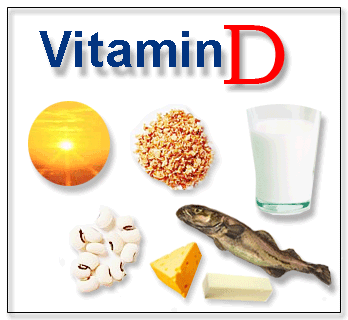
Usually we receive our vitamins from the foods we eat and the way we live. Milk, tuna, sunlight and orange juice are the best sources of vitamin D but aren't generally found in our fast food lifestyles.
"Lack of Vitamin D could spell heart trouble - Researchers issue recommendations to screen for and treat Vitamin D deficiency—which is traditionally associated with bone and muscle weakness—may also increase the risk of cardiovascular disease (CVD). A growing body of evidence links low 25-hydroxyvitamin D levels to common CVD risk factors such as hypertension, obesity and diabetes, as well as major cardiovascular events including stroke and congestive heart failure".- American College of Cardiology (December 2008)
When the president suggested checking the pressure in your tires as a way of improving fuel economy and his opponents laughed until they realized that the professionals in the automotive industry made the same suggestion and that the idea had merit. Sometimes the simplest ideas or rather the simple ideas can produce amazing results. A vitamin D deficiency can affect your ability to absorb calcium in a cascading effect. Cardiovascular disease (CVD) is problem for us locally. The simple solution might just be to give all of us above the age of fifty-five (55) cod liver oil which is highest in vitamin D. To those of us who can't stand the smell there are gel capsules. Whatever form we take its in as long as we take it we're certain that Pearlie Mae would be proud! It could save the lives of many of the residences of our jurisdictions as well.

Monday, February 8, 2010

Supplemental Bones

The University of California at Davis (UCD) seems to be the place to go for all research bones. Last month in the British Medical Journal (BMJ) - UC Davis research confirms benefits of calcium and vitamin D in preventing fractures - Taking both calcium and vitamin D supplements on a daily basis reduces the risk of bone fractures, regardless of whether a person is young or old, male or female, or has had fractures in the past, a large study of nearly 70,000 patients from throughout the United States and Europe has found. The study included data published in 2006 from clinical trials conducted at UC Davis in Sacramento as part of the Women’s Health Initiative (WHI). It appears online in this week’s edition of the British Medical Journal (BMJ).

Calcuim and Vitamin DThere are benefits in supplements and herbs that just aren't "all prevasive." Treatment like "bioidentical hormones" "(t)reatments are "individualized" or tailored to each person—it is not uncommon for different people with the same condition to receive different treatments. Homeopathic remedies are derived from natural substances that come from plants, minerals, or animals. Common remedies include red onion, arnica (mountain herb), and stinging nettle plant. Whether it's naturopathy and/or homeopathy offer hope for those searching for alternative remedies the disease care treatments with their own side effects and high percentage treatments with low percentage failures. Unlike conventional medicine the care is specialized specifically for each individual. Low or no rejects or negative interactions are all good things that can not be provided by one drug fits all.
“This study supports a growing consensus that combined calcium and vitamin D is more effective than vitamin D alone in reducing a variety of fractures,” said Robbins. “Interestingly, this combination of supplements benefits both women and men of all ages, which is not something we fully expected to find. We now need to investigate the best dosage, duration and optimal way for people to take it.” UCD
Vitamins good. Calcium good. Bones good. Vitamins make good calcium bones. Us Tarzans you Janes' and the research proves it again and again and again.

Tuesday, August 4, 2009

More Vitamin D Please

Once upon a time our parents made us take "One A Day" vitamins every day to get what we didn't get from our foods. Bayer no longer makes that formula. The problem we later learned as an adult is you get too many of one vitamin and not enough of the others. Not enough C or zinc and too much A. As an adult we moved to individual vitamins so we got more of what we needed and less of what we didn't. As we changed so did "One A Day" their current Teen Advantage brand gives just enough of the missing Vitamin D to protect your child. Vitamin D isn't a vitamin at all - it's a hormone!

For our children it could be a matter of life and death. The new report which again is another study of a study found: "Low vitamin D levels were especially common in children who were older, female, African-American, Mexican-American, obese, drank milk less than once a week, or spent more than four hours a day watching TV, playing videogames, or using computers. The researchers also found that low levels of vitamin D deficiency were associated with higher parathyroid hormone levels, a marker of bone health, higher systolic blood pressure, and lower serum calcium and HDL (good) cholesterol levels, which are key risk factors for heart disease."


The report's solution is our suggestion - more One A Day for teens: "Vitamin D supplementation can help. In the study, children who took vitamin D supplements (400 IU/day) were less likely to be deficient in the vitamin. However, only four percent of the study population actually used supplements. The American Academy of Pediatrics, which recently updated its vitamin D guidelines, now recommends that infants, children, and teens should take 400 IU per day in supplement form."

"Supplements are especially important for those living in the country's northern regions where the sun may be too weak to maintain healthy vitamin D levels. Supplements are also critical for infants who are breast-fed, say the researchers. Breast milk contains relatively little vitamin D, while formula is fortified with the vitamin."